
For more than a century, the Flavor and Extract Manufacturers Association of the United States (FEMA) has been committed to the safe and responsible use of flavor ingredients and inspiring nutritious choices through great-tasting foods and beverages. Flavors play an important role in foods and beverages by providing taste and aroma, helping make foods enjoyable. In nature, what we recognize as a food’s flavor is created by many individual components working together. For example, a whole peach has hundreds of different components which make a peach taste like a peach. Flavorists can create a peach flavor by taking the flavor components of the peach to create a flavorful peach yogurt or a peach sparkling water.
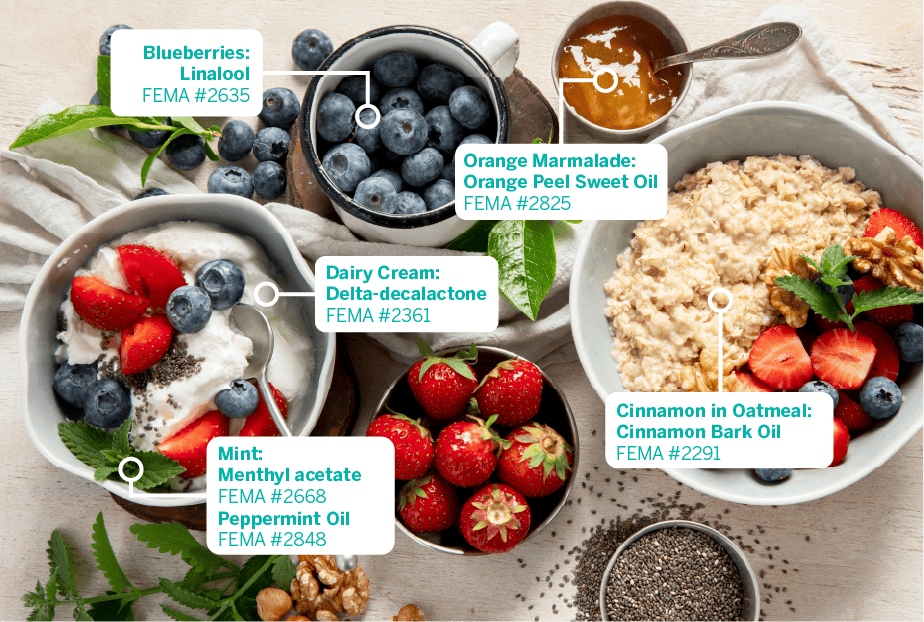
Whether they come from natural sources or are created to replicate flavors found in nature, flavor ingredients are used in very small amounts (often parts per million or fractions of a percent) and are carefully evaluated for safety before they are added to food.
Questions and misconceptions sometimes arise about how flavors added to foods and beverages are made and labeled. The information below addresses common questions about flavors and explains, in clear terms, how flavor safety and transparency are ensured so consumers can better understand how foods are made and labeled.
FEMA GRAS
- What is FEMA GRAS? Where can I find information about flavorings and flavor safety?
- Are flavor ingredients reviewed by industry insiders, instead of independent experts?
Labeling
- Why are flavors labeled using general terms like “peach flavor” and “natural flavor”?
- Do flavors contain undisclosed allergens?
FEMA GRAS
QUESTION: What is FEMA GRAS? Where can I find information about flavorings and flavor safety?
ANSWER: All flavor ingredients must undergo rigorous scientific safety evaluation before being used in food, based on established safety assessment principles, including advanced toxicology studies and exposure evaluations.
The FEMA GRAS program is the independent GRAS assessment program that performs these necessary, rigorous scientific safety evaluations. Information about flavorings and their safety is publicly available in the FEMA Flavor Ingredient Library and FDA’s Substances Added to Food Inventory.
Flavors have one of the most robust safety review systems in the food sector. The FEMA GRAS Program is based on safety reviews conducted by the FEMA Expert Panel, which has operated for more than 60 years and is recognized by the FDA.
A quick web search for “FEMA GRAS” leads to the FEMA Flavor Ingredient Library, a public resource that contains the entire list of FEMA GRAS flavorings. It also links to the safety information published by the FEMA Expert Panel, the FDA’s Scientific Literature Reviews, and the World Health Organization’s Joint Expert Committee on Food Additives (JECFA) safety reviews. In addition:
- After reviewing how GRAS determinations work in the U.S., the U.S. Government Accountability Office concluded that FEMA’s GRAS program “achieves a level of public disclosure and agency notification similar to FDA’s voluntary GRAS notification program.”
- FEMA GRAS determinations are submitted to the FDA and included in FDA’s official Substances Added to Food Inventory. The FDA is fully aware of which flavorings are used in foods and the safety data supporting them.
- FEMA GRAS flavorings have also been found to raise no safety concerns by international authorities, including regulators in the European Union, the World Health Organization, and Japan’s Ministry of Health.
- More than 100 countries recognize or accept FEMA GRAS flavorings either through regulation or in practice.
Key takeaway: The FEMA GRAS program represents a thorough and trusted approach to evaluating the safety of flavor ingredients. It is accepted by regulators and health organizations worldwide, as well as the close alignment of approved flavorings globally. After more than 60 years, FEMA GRAS is widely respected as a reliable and scientifically sound system for ensuring the safety of flavorings in food.
QUESTION: Are flavor ingredients reviewed by industry insiders, instead of independent experts?
ANSWER: No, flavor ingredients are reviewed by independent medical professionals and scientific experts.
Flavor ingredients are evaluated for safety by the FEMA Expert Panel, an independent panel made up of academics who are board-certified medical doctors and scientists with deep expertise in toxicology, medicine, chemistry, and food safety.
Panel members hold academic appointments at leading universities in the U.S. and internationally, including institutions such as Vanderbilt University, the University of Nebraska, the University of Minnesota, Imperial College London, and Wageningen University in the Netherlands.
These same experts are regularly selected to serve on government and international scientific advisory panels, including for the U.S. FDA and EPA, the European Food Safety Authority, Japan Ministry of Health, German Federal Institute for Risk Assessment, and the UK Food Standards Agency, to name a few.
Key takeaway: Flavor safety reviews are conducted by independent, highly credentialed experts who also advise governments and global health authorities.
LABELING
QUESTION: Why are flavors labeled using general terms like “peach flavor” and “natural flavor”?
ANSWER: Flavors are labeled according to strict FDA regulations which require the label to identify what the flavor is, how it was made, and where it comes from.
Think of coffee. During the coffee bean roasting process, hundreds of different components are formed that together create coffee’s familiar flavor. We call it “coffee” instead of listing each of those individual components. The name we use reflects what it is and how we experience it, not a detailed breakdown of every component of that flavor.
Flavor labeling works the same way. Flavors are defined by what they taste like and their source, rather than by listing every component that contributes to taste. Listing every component would not provide meaningful insight, improve label clarity, or provide a public health benefit.
This approach is used worldwide. No country or region, including the European Union, requires individual flavor components to be listed on food labels.
When flavors are added to food, their presence must be disclosed on the label under federal law. Labels clearly indicate when added flavors are present and whether the flavors are natural or artificial, ensuring that consumers are well informed.
Flavors are labeled this way because:
- Flavor recipes often contain dozens of ingredients used in extremely small amounts that do not affect nutrition, calories, dietary intake, or safety.
- Listing each component individually would make labels longer and more confusing, without providing additional public health benefits.
- This approach clearly communicates what matters most to consumers - that an added flavor is present and where it comes from.
Key takeaway: Flavor labeling is a transparent, standardized system designed to inform consumers with clear, accurate, relevant and useful information about the presence and source of flavors.
QUESTION: Do flavors contain undisclosed allergens?
ANSWER: No. Federal labeling laws require that all major food allergens be clearly disclosed on product labels, and flavors are not exempt from these requirements.
Under FDA regulations, allergens cannot be included under the term “flavor.” If a flavor is derived from a major food allergen, the allergen must be declared on the label. There is no evidence that undisclosed allergens enter the food supply through flavor components.
This disclosure provides vital information for people with food allergies, helping them to avoid ingredients that could harm them.
In addition, flavorings are typically produced using processes which would remove allergenic proteins.
Key takeaway: Flavor labeling rules help protect consumers with food allergies by ensuring that major allergens are clearly listed.
For more information, read the Frequently Asked Questions About Flavors.